홈 / ShortFling 블로그 / Industry
이 글은 현재 영어로만 제공됩니다.영어 버전 읽기 →
IndustryThe Little Prince AI Game: A 16-Day 3D Journey Built to Bring Visitors to One Site
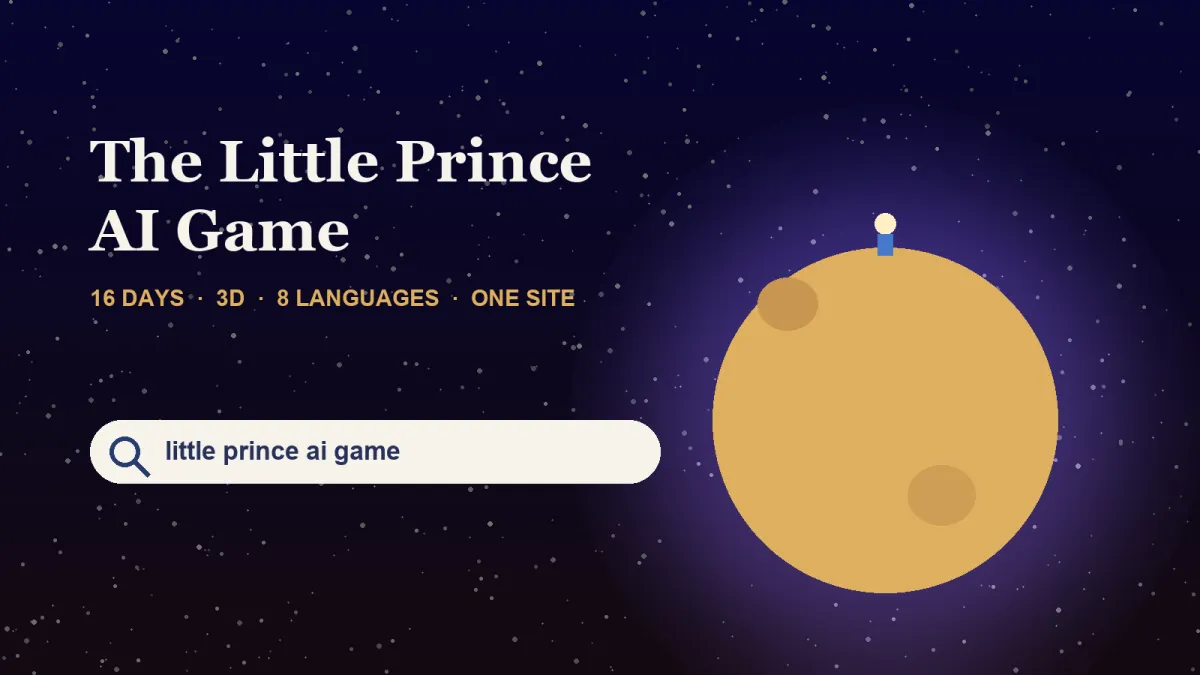
A 3D Little Prince game built in 16 days
What does a story about planets, encounters and goodbyes look like once it turns from text into a space you can explore? Creator Sac (X account @Saccc_c) answers with The Little Prince: Across the Stars. This Little Prince AI game is played in the browser. According to the author, it took 16 days, combining AI with 3D production tools, to turn the planets of the story into scenes you can walk through.
This article is not only about whether AI can build a game. Look at the launch cadence, the standalone domain, the language support and the directory listings together, and the game reads as a deliberate traffic move: a playable, searchable, linkable content asset that keeps steering social-media attention toward one site, littleprince.dev. If you want to see the work first, go straight to the Little Prince game at littleprince.dev. The analysis below is based on the author's public posts and third-party listings retrieved up to October 14, 2026. It is not a full playthrough review, and "traffic play" is this article's reading of the project's structure, not a quote from the author.
What is the Little Prince AI game, and where can you play it?
In the launch post on October 13, Sac introduced the project as a 3D story game based on The Little Prince, under the English title The Little Prince: Across the Stars. The core idea is to make the planets readers already know into three-dimensional spaces they can explore. The author also disclosed a 16-day production window and named Opus 5.5, Tripo and Blender. Both the timeline and the toolset come from the author's own statements. Source: launch post
If this is your first contact with the project, three facts are enough to confirm you have found the right thing: the author is Sac, the entry point is littleprince.dev, and the experience is 3D story and planet exploration. Those are the anchors when you search for "Little Prince AI game", "Sac Little Prince game" or "The Little Prince: Across the Stars".
On October 14, Sac posted an update: the game now supports eight languages, including Chinese, English, French and Japanese, and players are invited to report issues and share screenshots under the post. Source: multilingual update
The short version: this AI game exists to bring visitors to littleprince.dev
A game built in 16 days is unlikely to pay for itself through paid downloads or in-app purchases. What it can produce is an asset at the search and link layer:
A standalone domain catches all the traffic. The game is not on an app store or a games platform. It lives on the author's own site, littleprince.dev. Every repost, listing and search click ends on a domain the author controls, not on someone else's platform page.
It borrows an IP with existing search demand. The Little Prince is a book title people search for everywhere, all year. "Little Prince game" already has demand. Add fresh qualifiers such as "AI game", "3D" and "16 days" and you get long-tail queries with less competition and clearer intent.
Eight languages mean eight keyword sets. Multilingual support is not only a product feature. It lets the site appear in Chinese, English, French, Japanese and other search results at the same time.
A playable thing gets cited more than an article does. AI newsletters, game directories and tech media would rather link to a game you can open. Those backlinks and listings are the direct source of the authority a site builds up in search engines.
Put differently: "a 3D game made with AI in 16 days" is the promotional material. The search rankings and visits of littleprince.dev are where it lands. Every section below follows that thread.
Why The Little Prince suits a traffic-driving AI game
From an adaptation standpoint, The Little Prince fits spatial storytelling. A tiny planet can hold one person's whole life. One journey can string together very different encounters. Turn those relationships into scenes and the player has a clear reason to act: approach, observe, then understand.
From an SEO standpoint, the subject has three advantages. First, the work is in the public domain, so the book title can be the core term of the site and its headlines without rights issues. Second, "planets" are a natural content unit: each planet can become its own page, screenshot or shareable clip, so the site's indexable content grows with development. Third, the story has readers in many languages, so localized versions need no re-explanation of the premise. Translation cost is low and search coverage is wide.
This is an analysis of subject and form. It does not mean the game has been verified to use any particular level structure. Whether exploration helps players understand the story, and whether a line of dialogue arrives at the right moment, can only be answered by playing.
What 16 days means: AI brought the cost of an indexable content asset down to something acceptable
The most memorable fact about the project is "16 days". For SEO, the number matters because a content asset that can bring long-term search traffic now takes about as long to produce as a series of in-depth articles. A 3D entry point that once needed a team for months can now be shipped by one person with AI and 3D tools, and it is a crawlable web page from day one.
That said, the figure should be read as the author's record for this project, not as proof that anyone can build a game of the same quality in the same time. The disclosed tools (Opus 5.5, Tripo, Blender) show AI and 3D software sharing one pipeline, but the public information cannot reconstruct the full process: which parts were model-generated, which were hand-edited, how much time debugging took. None of that can be inferred from tool names alone. It is especially unwise to reduce this case to "one prompt produced a whole game".
For anyone who wants to copy this traffic route, the most valuable material still to come is the production steps, change history, asset handling and real cost. In the launch post the author said the whole game and a detailed making-of would be published later. If that happens, those pages become a second wave of searchable, linkable content. Source: launch post
How the X distribution chain turns into search traffic
The material found in this search includes the author's launch and update posts, an AI newsletter excerpt and a game directory listing. The Lin Xiaohang AI Daily listed the project among the trending X cases of October 14, noting the production window and the open-source plan. Play AI Games provides a description and an outbound link. Source: Lin Xiaohang AI Daily; Play AI Games listing
Connect those nodes and you get a textbook path from social buzz to search asset:
1. The author posts on X with a familiar story, a concrete production window and a link you can open.
2. Newsletters and directories relay it with the link, giving the site its first external references.
3. People who saw the discussion search for "Little Prince AI game" or "littleprince.dev", and the brand term plus long-tail queries start to carry volume.
4. What shows up in those results is the author's own domain, not a platform page.
Attention on X fades in days. Directory listings, backlinks and rankings stay. That is the argument for hosting the game on a standalone site instead of only posting a video. This reading comes from the structure of the public material, not from traffic statistics.
The author's follow-up, adding languages and asking for feedback, moves the project into maintenance. Once a work gets attention, the new problems usually cluster around loading, device differences, controls and language quality. Those same issues shape visit duration and return visits, which is how the site performs in search. Collecting feedback helps surface them, but it does not mean they are already solved. Source: feedback request post
What indie developers and site owners can take from it
First, plan the game as a content asset of the site. The more specific the goal, the easier it is to judge whether a technique or an asset serves the work. In the same way, decide which search terms the game should capture and which domain it should land on before deciding what to build. Tool choices get much clearer.
Second, an accessible entry point beats any description. Readers can open the game right after the discussion, and media and directories prefer to link to something playable. A standalone domain, a clear brand name (The Little Prince: Across the Stars) and an author identity that search can confirm (Sac / @Saccc_c) are the basic kit for earning links on a project like this.
Third, languages and the open-source plan both extend the traffic line. Eight languages turn one game into several search entry points. Publishing the making-of attracts a different audience that follows AI game development. Language expansion, feedback collection and bug fixing after launch are all part of the same traffic route.
The lesson of this case is to test a new way of making and a new way of acquiring users with one concrete work: set a clear experience goal and a clear search goal, let the tools serve them, then correct course with player feedback and search data.
Where to start
For readers who love The Little Prince, follow 3D storytelling, or study AI game development and site traffic, this project is a concrete thing to watch: a familiar story reorganized by a new production method into a space you can enter, and that space is itself the site's traffic entry point. Start at the Little Prince 3D game, then go back to the author's public record to understand how this journey across the stars was built, and how it gets found.
FAQ
Where can I play the Little Prince AI game?
The address published by the author is littleprince.dev. Start there to learn about and try the work. Check the game page for system requirements.
Who made the game?
The author is Sac, X account @Saccc_c. This article discusses The Little Prince: Across the Stars as published by that account.
Does the Little Prince game support Chinese?
According to the author's update of October 14, 2026, the game supports Chinese, plus English, French, Japanese and others for eight languages in total. This cites the author's announcement; the language content has not been tested item by item. See the update
Is the game open source yet?
In the launch post the author said the full game and a detailed production process would be published later. This search found no public code repository, so treat it as a plan to open-source, not as something already released. See the original post
Does "AI game" mean characters generate dialogue in real time?
The available material shows that AI took part in production. It does not confirm that the game generates story or character dialogue live during play. Using AI to build a game and having AI generate content at runtime are two separate claims that need separate verification.
How does an AI game bring search traffic to a site?
The route: host the game on your own domain; combine a subject with existing search demand and fresh qualifiers into long-tail keywords; publish an openable link on social platforms to earn listings and backlinks from newsletters, directories and media; then widen the number of indexable pages with languages and a public making-of. The buzz passes, but the listings and rankings on the domain remain. This is the article's analysis of the project's structure. Actual results have to be verified with search data after launch.
Sources
- Sac (@Saccc_c) launch post: The Little Prince: Across the Stars, 16 days, Opus 5.5 + Tripo + Blender (checked 2026-10)
- Sac (@Saccc_c) update: eight languages and feedback request (checked 2026-10)
- Lin Xiaohang AI Daily (jedeeai.com), 2026-10-14 trending X cases (checked 2026-10)
- Play AI Games listing (checked 2026-10)
- The Little Prince: Across the Stars (littleprince.dev) (checked 2026-10)